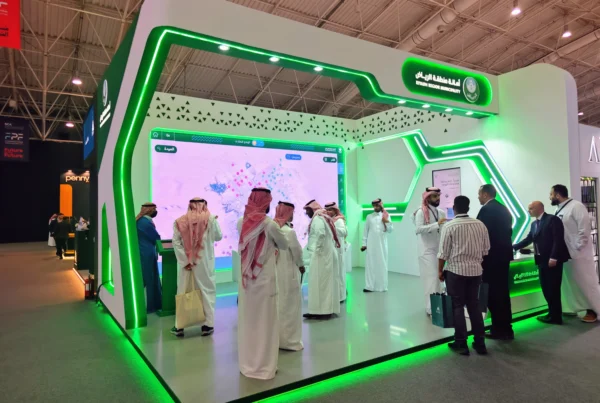
A real estate digital twin can improve marketing efficiency when it replaces repeated 3D production with one governed environment that supports websites, sales centres, exhibitions and campaign content. It can also help sales teams explain complex developments more clearly. Neither result is automatic.
Digital twins for real estate create value through reuse, faster adaptation and better sales conversations. To prove return on investment, developers should measure total ownership cost, the number of approved outputs reused, qualified lead progression and commercial outcomes. More screen time alone is not ROI.

What should a real estate digital twin do?
The term digital twin covers different levels of maturity. The Digital Twin Hub foundation guide for the built environment provides a useful starting point: the purpose, information and connection to the physical asset should be clear. A real-time sales application is not automatically an operational building twin with live sensor data.
For marketing and sales, the most useful definition is practical. A real estate digital twin is an interactive, governed representation of a development that helps people understand its location, masterplan, buildings, amenities, unit options and approved commercial information. It may connect to inventory, CRM, GIS or operational data when the project requires those integrations.
Call the product what it really is
If the environment is a high-quality interactive sales model without live synchronization, describe it as an interactive commercial twin or real-time development experience. If data flows between the physical asset and the digital representation, explain which data, how often it updates and who governs it.
The commercial twin should solve buyer and advisor questions. Can a visitor understand where the project sits in the city? Can an advisor move from the masterplan to a relevant building in seconds? Can the team compare unit types without exposing unapproved data? Can the same approved environment produce campaign views without rebuilding everything?
Where real estate marketing budgets are often lost
Digital twins do not create savings simply because they use real-time technology. The budget opportunity appears when a developer would otherwise commission overlapping assets, repeat the same modeling work or maintain several inconsistent versions of the project.
The website, film, event application and sales centre start from different 3D files or separate suppliers.
Old amenities, phase names, layouts or views remain in circulation after the approved project changes.
Teams buy an event activation, a web viewer and CGI outputs before defining the shared content foundation.
A visually impressive application is delivered without fast routes, advisor training or a clear handoff to the next action.
The alternative is not one identical application on every device. Each channel still needs appropriate controls, performance and storytelling. The reusable part is the approved environment, asset library, data model and content governance behind those experiences.

How to build a credible budget case
Do not compare the digital twin only with the price of a small CGI package. Compare it with the full group of outputs, updates and deployments the development actually needs over the commercial life of the project.
Core environment + data preparation + channel applications + integrations + hosting + maintenance + support
Keep hardware and event operations visible as separate cost lines. They may use the twin, but they are not the same product.
Then estimate the work that can genuinely be reused: approved geometry, materials, landscape, camera positions, project information, interface components and data connectors. Avoid counting a theoretical output as a saving unless it was already planned and budgeted.
Use three budget questions
- What will be built once? Identify the spatial core, asset library, data structure and approval process.
- What will still be adapted? List web optimization, exhibition controls, film editing, languages, accessibility, device testing and sales workflows.
- What will be maintained? Define design changes, inventory updates, hosting, engine upgrades, analytics, support and ownership.
A useful procurement brief should also define change limits. If new design information arrives after sign-off, the team should know what counts as a correction, what counts as a change request and which channels must be updated. Our guide to building a digital twin RFP explains how to make those boundaries explicit.
One core can support different commercial touchpoints
Website
Self-guided discovery, campaign landing pages and remote follow-up.
Sales centre
Advisor-controlled masterplan, unit comparison and guided meetings.
Exhibitions
Fast project storytelling for LED displays, touchscreens and shared audiences.
Campaign content
Approved stills, films and presentation views generated from the same environment.
CRM and inventory
Buyer context, availability and the next action, subject to approved integrations.
How digital twins can support real estate sales
A digital twin does not close a deal by itself. Its job is to make a complex project easier to understand and give the sales advisor a better way to respond to the buyer’s priorities.
The buyer may need to move between several scales: city context, development, phase, building, floor, unit and view. A well-designed interface preserves that context. It also exposes only useful, approved information instead of turning the meeting into a technical demonstration.
The 2025 National Association of REALTORS report offers relevant directional evidence from US buyers who used the internet. Among those respondents, 83% rated photos as very useful, 79% detailed property information, 57% floor plans, 41% virtual tours and 30% interactive maps. This is not a forecast for every market or an ROI benchmark for digital twins. It does show that buyers value visual information and practical property detail together.
For off-plan developments, the strongest sales journeys usually combine emotion with verification. The environment can create a sense of place, but it should also help the buyer check location, access, amenities, unit relationships, views and approved availability. See our related guide to digital twins for off-plan pre-sales.
How to measure marketing and sales ROI
Start measurement before production. Define the buyer actions, the sales stages and the baseline you will use for comparison. A project view, unit comparison or brochure download can help assess content quality, but it is not automatically a qualified lead.

Google Analytics currently supports recommended lead-generation events including generate_lead, qualify_lead and close_convert_lead. Google’s lead acquisition report guidance explains how those events populate new, qualified and converted lead metrics. Custom interaction events can describe what people explored, while CRM stages should confirm what happened next.
| Metric | What it answers | Planning note |
|---|---|---|
| Approved output reuse | How many planned website, event, showroom and campaign outputs used the governed core? | Count approved deliverables, not hypothetical possibilities. |
| Cost per approved output | Did total content-system cost produce more useful outputs than the previous approach? | Include maintenance, hosting and adaptation costs. |
| Engaged exploration rate | Did visitors reach meaningful project or unit content? | Define meaningful depth and time for the specific journey. |
| Qualified lead rate | How many leads met the client’s documented qualification criteria? | Do not label every interaction as a lead. |
| Appointment progression | Did engaged visitors book or attend a relevant sales conversation? | Connect campaign, digital twin and CRM identifiers responsibly. |
| Influenced pipeline | Which qualified opportunities used the digital twin during their journey? | Report influence separately from direct attribution. |
Website performance still matters
Do not force a heavy interactive experience to load before the visitor understands the offer. Use a fast editorial landing layer, a clear launch action and an appropriate fallback. Google Search recommends loading relevant lazy content when it becomes visible, without requiring clicks or swipes that a crawler will not perform.
What real projects and market examples actually prove

Jeddah Central
The project shows how a large development can be presented through an interactive environment on a shared display. It is evidence of deployment, audience access and project communication. Without client-approved commercial data, it should not be presented as proof of a specific conversion increase.
DAMAC and PropVR
An Epic Games spotlight published in 2025 reports major sales and engagement results attributed by PropVR to a broader DAMAC technology stack. The case shows commercial potential, but the figures are company-reported and should not be treated as a universal benchmark or a forecast for another developer.
Good evidence distinguishes what was delivered, how teams used it and what was measured. If commercial outcomes are confidential, show the implementation clearly and avoid replacing missing data with assumptions.
When should a developer invest in a digital twin?
Strong fit
- Large or mixed-use development with spatial complexity
- Several phases, buildings or unit categories
- Multiple channels over a long marketing period
- Need for guided and self-guided presentation
- Approved owner for data, content and updates
- Sales team committed to daily use
Weak fit or wrong timing
- Only a few static campaign images are required
- The design changes faster than information can be governed
- No clear audience, sales journey or next action exists
- Inventory and commercial data have no reliable owner
- There is no maintenance, hosting or support plan
- The team expects technology alone to fix a weak offer
The decision should be based on the portfolio of required outputs and buyer journeys, not on novelty. If a small project needs only several approved renders and a brochure, high-quality CGI may be the more efficient choice. If a complex development needs years of coordinated website, showroom, event and campaign content, a reusable real-time core can be strategically stronger.
A practical implementation plan
- Define decisionsList the buyer questions, advisor tasks and commercial next actions the experience must support.
- Audit inputsConfirm models, drawings, imagery, project facts, inventory, languages and approval owners.
- Prototype the journeyTest navigation and sales routes before full-fidelity production begins.
- Build the governed coreCreate reusable assets, naming rules, version control and a clear change process.
- Adapt each channelDesign web, showroom and event interfaces for their actual audiences and devices.
- Measure and maintainConnect interaction, lead and commercial reporting, then review reuse and support needs.
For exhibition deployment, continue with our guide to the interactive real estate booth journey. To explore Chameleon’s commercial approach, see our real estate digital twin solutions.
Planning a real estate digital twin?
We can help define the commercial journey, reusable content architecture, deployment channels and measurement plan before production starts.
Frequently asked questions
What is a real estate digital twin?
For marketing and sales, it is an interactive, governed representation of a development that helps buyers and advisors understand location, masterplan, buildings, amenities, unit options and approved commercial information. Operational twins may add live data from the physical asset.
How can a digital twin reduce real estate marketing costs?
It can reduce repeated 3D rebuilding when several planned outputs reuse the same approved environment and asset library. Savings are not automatic because channel adaptation, integrations, updates, hosting and support still require budget.
Does a digital twin replace CGI renders and films?
No. A real-time environment can become a production source for some stills and films, but campaign art direction, editing, retouching, sound, copy and channel preparation remain separate tasks.
Can a real estate digital twin connect to CRM and inventory?
Yes, if the integration is planned and the client has approved data ownership, update rules, security, privacy treatment and fallback behavior. The visual experience should never display unapproved or stale commercial information.
How should digital twin ROI be measured?
Measure total ownership cost, approved output reuse, cost per approved output, meaningful exploration, qualified lead progression, appointments and influenced pipeline. Separate interaction signals from CRM-confirmed lead stages and commercial results.
When is a real estate digital twin unnecessary?
It may be unnecessary when a project needs only a small set of static assets, lacks stable approved inputs, has no clear buyer journey or cannot fund maintenance and support. In those cases, focused CGI or a simpler interactive presentation may be more efficient.
Editorial sources: Digital Twin Hub foundation guidance, National Association of REALTORS 2025 buyer research, Google Analytics lead-acquisition guidance, Google Search lazy-loading guidance and Epic Games’ PropVR/DAMAC spotlight. External commercial claims are identified as company-reported rather than presented as general benchmarks.