Practical planning guide
Budget the experience-not the equipment list.
An immersive booth is not one purchase. It is a connected product made of content, technology and show delivery. Budget those three systems together and the result is easier to defend, operate and remember.
- Experience strategy
- LED + real-time systems
- Show-day reliability
The central idea
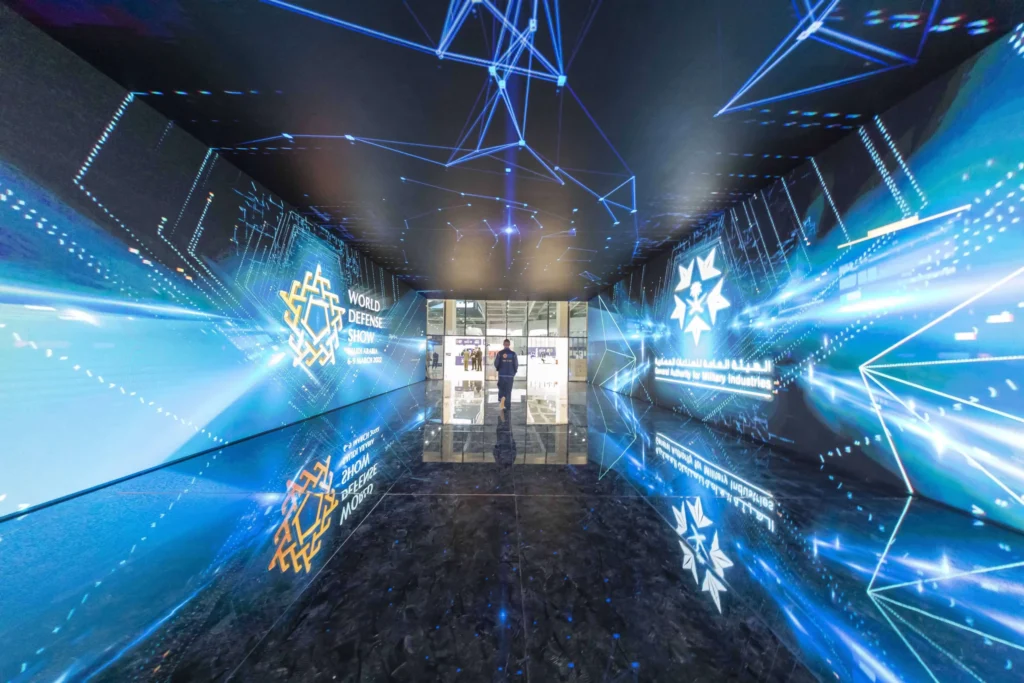
Most clients do not ask for an LED wall. They ask for a moment when a visitor stops, understands the proposition and chooses to continue the conversation. The budget should protect that moment from concept to show floor.
The quick answer
- Define the visitor journey before specifying hardware.
- Model the budget in three buckets: Experience, System and Show.
- Save by simplifying scope and architecture-not by removing reliability.
- Price the venue, logistics and testing window before the design is frozen.
Experience. System. Show.
This three-part model prevents the two most common failures: treating content as an afterthought and discovering show costs when the design can no longer change.
Experience
What the audience understands, feels and does.
- Story and demo script
- UX and interaction logic
- 3D, motion and data content
- Presenter and self-guided modes
Ask: what must a visitor remember 24 hours later?
System
What makes the experience run, respond and recover.
- LED and signal processing
- Render workstation or media server
- Control devices and sensors
- Network, monitoring and redundancy
Ask: what happens when a component or connection fails?
Show
What gets the system installed, approved and supported on site.
- Rigging, structure and power
- Freight and material handling
- Venue labour and overtime
- Commissioning and live support
Ask: which costs sit in the exhibitor manual, not the design deck?
These are early planning ranges, not a quotation. The mix shifts with venue rules, content maturity, screen size, interactivity and the cost of downtime.
Six decisions move the budget.
The question is not whether each category is expensive. It is which requirement makes it complex and whether that complexity creates visible value.
Content and interaction scope
A guided story with three clear modes is fundamentally different from an open-ended digital product with many states, languages and user roles.
Decide earlyWho controls the experience, what the key demo modes are, and what “finished” means.
Display geometry and viewing distance
Pixel pitch, screen shape, brightness and resolution should follow real viewing conditions and content legibility not a specification race.
Decide earlyClosest and farthest viewer, critical text size, screen dimensions and whether the surface is flat, curved or architectural.
Real-time compute and signal
Video playback is not the same workload as an interactive Unreal Engine scene. Pixel count, frame rate, output count and synchronisation determine the architecture.
Decide earlyTotal canvas resolution, real-time features, number of outputs, recovery target and required headroom.
Interaction layer
Tablets, touchscreens, sensors, cameras, RFID and tangible objects add more than hardware. They add integration, calibration, reset states and support.
Decide earlyWhich interactions materially improve the journey and which merely add novelty.
Network and operational control
The cost is rarely the router. It is designing a stable booth network, securing approvals, testing the full path and giving staff simple controls.
Decide earlyDedicated LAN or venue network, external access, device ownership, monitoring and offline behaviour.
Venue, logistics and support
Rigging, power, freight, material handling, labour jurisdictions, storage, overtime and on-site technicians can reshape the budget after the creative work is approved.
Decide earlyVenue rules, delivery route, shipment class, install window, rehearsal time and who is on call during the show.
Save without weakening the promise.
The strongest savings remove invisible complexity. The weakest savings remove the testing, clarity and resilience that make the experience feel premium.
Save here
- Choose pixel pitch from viewing distance and content, not prestige.
- Build three repeatable demo modes instead of an unlimited feature list.
- Reuse modular 3D assets, interface patterns and control architecture.
- Reduce “special devices” by using browser-based control where appropriate.
- Consolidate freight and design lighter, modular scenic and AV elements.
- Freeze decisions before venue deadlines and overtime windows.
Do not cut here
- Full-system commissioning with the final pixel canvas.
- Operator UX, reset states and a documented recovery path.
- Power, network and signal planning.
- Appropriate spares or redundancy for mission-critical components.
- Content optimisation for the actual display and viewing distance.
- On-site support when downtime would damage a high-value event.
The rule: simplify the architecture, not the audience promise.
Three useful starting points.
These are scope patterns, not price packages. Use them to align ambition before requesting quotations. The allocation bars show an illustrative starting split.
Scenario A
Guided hero wall
High visual impact with a presenter-led story and simple tablet control.
- Best for
- Launches, headline messages and fast visitor throughput.
- Prioritise
- Screen presence, strong content and frictionless operation.
- Simplify
- Fewer modes, fewer endpoints and one clear narrative.
Scenario B
Interactive explorer
A deeper real-time story with layered content, multiple paths and operator modes.
- Best for
- Real estate, infrastructure and complex propositions.
- Prioritise
- UX, content depth, real-time performance and repeatability.
- Simplify
- Choose fewer, stronger layers and define completion criteria.
Scenario C
Flagship multi-zone
Multiple surfaces or experiences with higher throughput, support and resilience.
- Best for
- High-stakes pavilions, VIP programmes and destination booths.
- Prioritise
- System architecture, orchestration, redundancy and live support.
- Simplify
- Share infrastructure across zones and standardise operations.
Numbers represent percentage points in an illustrative 100-point planning model. Actual allocations vary by project and market.
Questions that keep the budget real.
Ask these before comparing supplier totals. A cheaper number is not cheaper if it excludes the work required to open on time.
- What is included in creative development, revisions and content optimisation?
- What is included in installation, integration, commissioning and rehearsal?
- Who owns the network, devices and approval process on site?
- What resolution, frame rate, outputs and redundancy are included?
- What is the recovery plan if a tablet, workstation or signal path fails?
- Which spares and on-site support hours are included?
- What do venue labour, rigging, power and material handling add?
- What changes after final scope, venue deadlines or overtime begins?
Use standards to remove guesswork.
Technical guidance is a starting point, not a substitute for testing the exact content, canvas and operating conditions.
Useful for relating content size, image height, resolution and viewing distance more defensible than choosing a display by instinct.
A baseline for Unreal Engine development. Event-grade systems still need headroom for the final canvas, duty cycle and recovery requirements.
An example of professional LED processing capabilities, including processor redundancy support.
A practical reminder that unloading, booth delivery, empty storage and outbound reloading are distinct show services.
Bring us three inputs.
We can help you pressure-test the experience, system and show logic before the expensive decisions become fixed.
- 01 Booth footprint and event location
- 02 Main KPI: meetings, leads, awareness or sales
- 03 Hero surface and number of experience zones
Related field guides.
Go deeper into strategy, interaction architecture and real-time delivery.
Immersive experience budgeting
What are the biggest cost drivers?
Usually the experience and content scope, the display and processing chain, real-time compute, interaction devices, and show delivery. The mix changes with venue rules, canvas resolution, content maturity and the cost of downtime.
Why is LED price per square metre not the total budget?
Panels are only one part of the system. Processing, structure, rigging, power, installation, signal distribution, calibration, content resolution and reliability all contribute to the delivered cost.
How should we choose pixel pitch?
Start with the closest and farthest viewer, the smallest critical content and the actual screen dimensions. Then verify legibility using a recognised method such as AVIXA DISCAS and test representative content.
What determines media-server or workstation cost?
Total pixel load, frame rate, output count, synchronisation, real-time rendering features, monitoring, failover and recovery requirements. A machine that merely runs the demo in a studio is not automatically a show-ready system.
Where can we save without making the experience feel cheaper?
Control feature scope, reuse assets, simplify device architecture, choose display specifications from real viewing conditions, reduce freight weight and make decisions before late venue deadlines.
What should never be left until show week?
Power and network planning, full-canvas performance testing, operator controls, reset and recovery behaviour, venue labour requirements, commissioning time and ownership of on-site support.